
When people think about living in Ocean County, the water usually gets all the attention.
Barnegat Bay. The ocean. Lagoons. Marinas. Boardwalks.
Drive west for a few minutes, though, and Ocean County starts telling a completely different story.
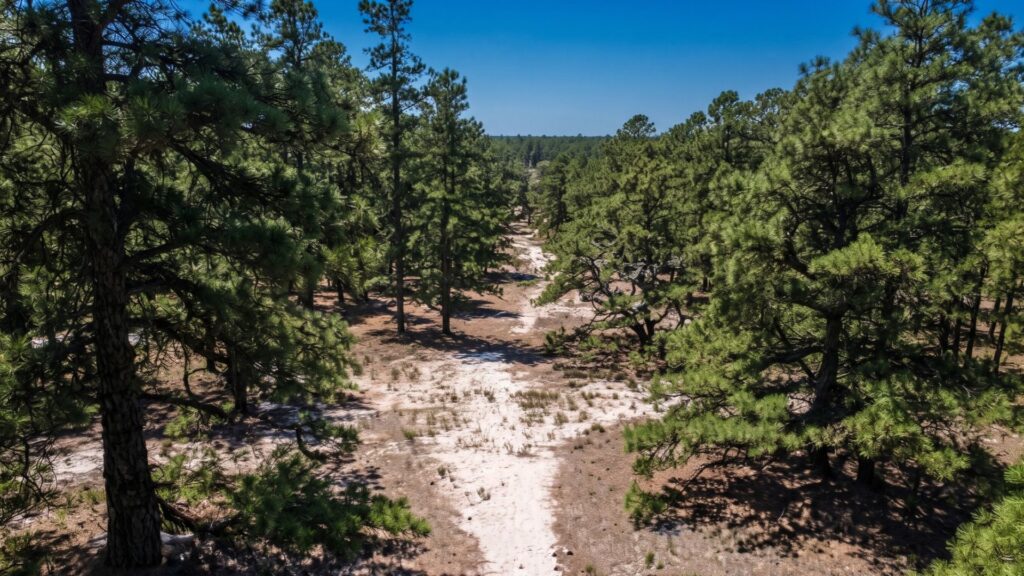
Pine trees replace bay views. Roads become quieter. Lots get larger and more wooded. Cedar-colored streams wind through the landscape. Places like Double Trouble, Wells Mills and the Forked River Mountains remind you that a huge part of the Jersey Shore sits right beside one of the most unusual ecosystems in the Northeast.
The New Jersey Pinelands covers more than a million acres across portions of several counties, including Ocean County. Much of central and southern Ocean County is characterized by Pinelands forests, wetlands and waterways rather than beachfront development.
And owning a home near all that open space can be fantastic.
But it can also come with questions that don’t necessarily come up when you’re looking at a typical suburban lot.
So what should you know if the house you’re considering sits closer to the pines than the bay?
First, A Wooded Lot Is Not Necessarily a Blank Canvas
A large wooded property can immediately get your imagination going.
Maybe you’ll add a detached garage.
Clear space for a pool.
Build an addition.
Put in a bigger driveway.
Take down some trees to open the yard.
Before designing any of that in your head, find out exactly what rules apply to the property.
The Pinelands Comprehensive Management Plan divides the region into different land-use management areas, each with its own development goals, permitted uses and intensity standards. Those standards are implemented through municipal zoning that must conform with Pinelands requirements.
Depending on the property and the project, development may involve municipal approvals, Pinelands review or environmental considerations such as wetlands.
The Pinelands Commission even provides a formal process for determining whether wetlands exist on a property and what buffer may be required.
So if you’re buying because you have plans for the land, verify those plans before making the property work in your imagination.
A wooded acre can be beautiful.
That doesn’t automatically mean every square foot is buildable.
Septic Systems May Be Part of the Deal
Another difference you’ll encounter more frequently in less-developed portions of the Pinelands is onsite wastewater treatment.
Many properties in the region rely on septic systems rather than municipal sewer service.
That’s not unusual or automatically problematic. Properly designed and maintained septic systems are an established part of the Pinelands’ wastewater infrastructure. But the environmental rules surrounding them are taken seriously because treated wastewater ultimately recharges local groundwater.
The Pinelands Commission’s standards are also more nuanced than simply asking, “Does the house have septic?”
Conventional systems are tied to development-density and water-quality standards, and specialized higher-performance systems can be required for certain smaller parcels.
If you’re buying a property served by septic, New Jersey DEP recommends obtaining a septic inspection before purchase. That inspection can help identify current condition and whether the system may affect future projects such as additions, decks or swimming areas.
In other words:
Don’t just ask where the septic tank is.
Understand the system you’re buying.
A Private Well Means You’re Also Buying Your Own Water System
Some wooded and rural properties may also use a private well instead of public water.
That changes the homeowner’s role.
With municipal water, the utility tests the public supply.
With a private well, the homeowner is responsible for monitoring the water.
New Jersey’s Private Well Testing Act requires qualifying residential properties supplied by private potable wells to have the untreated groundwater tested as part of a sale. Both buyer and seller must receive and review the results before closing.
The state also recommends regular testing after you own the home because groundwater quality can change over time.
That doesn’t make a well a negative.
Plenty of homeowners live happily with private wells.
It simply means “Where does the water come from?” deserves a more specific answer than turning on the kitchen faucet and seeing that water appears.
Then There’s Wildfire
This is one subject that shouldn’t be ignored when talking about living near heavily wooded areas of the Pine Barrens.
And Ocean County has a very recent example.
The Jones Road Wildfire, which began in April 2025 in the Forked River Mountains area, ultimately burned 14,949 acres. It threatened 1,320 structures, prompted the evacuation of roughly 7,000 residents in Ocean and Lacey townships and temporarily affected major transportation routes including Route 9 and the Garden State Parkway.
It was an extraordinary event, not something happening outside someone’s window every week.
But it made wildfire awareness difficult to dismiss.
New Jersey’s first annual wildfire report, released in June 2026, found that the state experienced 1,322 wildfires during 2025, burning more than 27,000 acres. Nearly all—99.6%—were attributed to human causes. The state also noted that wildfire risk is extending beyond what was traditionally thought of as the spring fire season.
For homeowners, the useful takeaway isn’t panic.
It’s property maintenance.
NJDEP’s Wildfire SMART guidance encourages owners of wooded properties to reduce combustible material close to structures, clear leaves and pine needles, manage vegetation and maintain access for emergency vehicles. The state’s guidance calls for especially significant defensible space around homes in the Pinelands.
That turns something as ordinary as cleaning pine needles out of the gutters into more than a cosmetic chore.
Those Beautiful Trees Come With Homework
Privacy is one of the biggest reasons people love wooded properties.
You may have fewer direct views into neighboring yards, more shade and a feeling of separation that can be difficult to find closer to the bay or larger commercial corridors.
But trees are part of the property.
They drop branches.
They shed leaves and pine needles.
They can hang over roofs and driveways.
Storms can expose weaknesses you didn’t notice on a calm showing day.
And around wildfire-prone landscapes, dead vegetation and accumulated debris deserve attention.
When touring a wooded home, don’t only look at the house.
Look up.
Which trees are close to the structure?
Are large limbs hanging over the roof?
How much vegetation surrounds the driveway?
Could emergency vehicles comfortably reach the house?
How much leaf and pine-needle cleanup would this property realistically require?
A wooded lot can be one of the property’s best features.
Just make sure you like owning the trees as much as you like looking at them.
Water Still Matters—Even When You Can’t See the Bay
Here’s one of the more interesting things about the Pine Barrens.
The landscape may look dry and sandy in one direction while hiding cedar swamps, wetlands, streams and groundwater systems nearby.
The Pinelands is shaped by both fire and water, with sandy forests sitting alongside rivers, wetlands and cedar swamps connected to the enormous Kirkwood-Cohansey aquifer system.
That’s one reason environmental restrictions exist.
If you’re considering a property with a large wooded parcel, don’t automatically assume every low area is simply “unused backyard.”
Wetlands, buffers, drainage and groundwater conditions can affect what you may eventually be able to do with the land.
This is another place where official property-specific research matters more than assumptions based on what neighboring homeowners appear to have done.
The Payoff Is a Very Different Version of Ocean County
All of those practical considerations can make this sound more complicated than it really is.
There’s another side to it.
Living near the Pinelands can mean having thousands of acres of protected open space practically in your backyard.
Double Trouble State Park in Bayville, for example, protects more than 8,000 acres of Pine Barrens landscape around Cedar Creek, historic cranberry bogs and Double Trouble Village. Its trail system winds through pine forest, cedar swamp and the remains of a community once built around lumber and cranberry production.
It’s one reason our Bayville local guide feels so different from a traditional Jersey Shore article.
Head east and Bayville reaches toward Barnegat Bay.
Head west and you’re suddenly in the Pine Barrens.
Forked River has a similar contrast. Our Forked River local guide starts near marinas, the river and Barnegat Bay, but Lacey Township also reaches deep into wooded Ocean County.
The Shore and the Pines aren’t two completely separate places here.
They’re neighbors.
The Commute Can Matter More Than the Acreage
A quiet road surrounded by pine trees can feel pretty convincing during a Saturday showing.
Now picture Tuesday morning.
Where is the nearest grocery store?
How long does it actually take to reach Route 9?
What does the drive to the Garden State Parkway look like during normal commuting hours?
Where is your doctor?
School?
Daycare?
Gym?
Coffee?
If you’re moving from a denser part of New Jersey, a few extra miles may not sound significant.
Living them every day can feel different.
That’s why I always like the idea of driving the area without a showing appointment.
Visit in the morning.
Come back after dark.
Drive the route you’d actually use.
See where everyday life happens.
A house can give you privacy without needing to feel isolated.
The trick is figuring out where that line is for you.
If You’re Selling a Wooded Property, Documentation Can Be Part of the Value
The same questions buyers should ask can help sellers prepare.
If the property uses septic, know what system you have and gather available maintenance records.
If there’s a private well, understand the testing process.
If you’ve completed additions, outbuildings or major site work, locate available permits and approvals.
If you’ve maintained defensible space or completed significant tree work, keep records where appropriate.
And if your property borders protected land or has environmental constraints, don’t try to turn every acre into a selling claim.
Sometimes the real value is exactly what isn’t going to be developed.
Privacy.
Trees.
Open space.
Trails nearby.
A quieter setting.
Those things can speak for themselves.
So, Is Living Near the Pine Barrens Right for You?
There isn’t one answer.
Some people would trade a bay view for a wooded backyard without thinking twice.
Others want sidewalks, public utilities and restaurants around the corner.
Some people love having a well and septic because they’re comfortable managing those systems.
Others strongly prefer municipal utilities.
Some want an acre surrounded by pines.
Others would rather have almost no yard maintenance at all.
That’s why choosing where to live in Ocean County gets much more interesting than simply asking:
Beach or no beach?
There are several different versions of life here.
And the Pine Barrens side may be one of the least understood.
The Other Jersey Shore Is Worth Knowing
Ocean County isn’t just coastline.
Its interior is filled with pine forest, cedar swamps, sandy roads, freshwater streams, protected land and communities that live right along the edge of that landscape.
That can create beautiful properties.
It can create privacy that’s hard to replicate elsewhere.
And it can put some remarkable outdoor places surprisingly close to home.
It simply comes with a different set of questions.
Where does the water come from?
Where does the wastewater go?
What can actually be built on the lot?
How should the property be maintained around wildfire risk?
What would daily life feel like this far from the commercial corridors?
Those aren’t reasons not to buy.
They’re the questions that help you understand what you’re buying.
And around the Jersey Shore, sometimes the home that fits you best isn’t the one closest to the water.
It might be the one tucked into the pines.
Keep Exploring Ocean County
If you want to see this contrast for yourself, start with our Bayville local guide, where Barnegat Bay and the Pine Barrens meet in the same community.
Our Forked River guide explores another part of Ocean County where the waterfront, lakes and wooded landscape all overlap.
And for the broader area, visit Best Things to Do in Ocean County, NJ.
If you’re comparing the wooded side of Ocean County with living closer to the bay, our Living Near Barnegat Bay guide looks at the completely different ownership questions that come with waterfront property.
About Michael Tumminelli
Michael Tumminelli is a Broker Associate serving Ocean and Monmouth Counties. He helps buyers and sellers understand not just the house itself, but the land, location and everyday lifestyle surrounding it.
Michael Tumminelli | Broker Associate
848-333-3420
732-473-1700
michaeltumminellirealtor@gmail.com